

Fake Crochet Patterns Are Fooling Makers. Here’s How to Spot Them
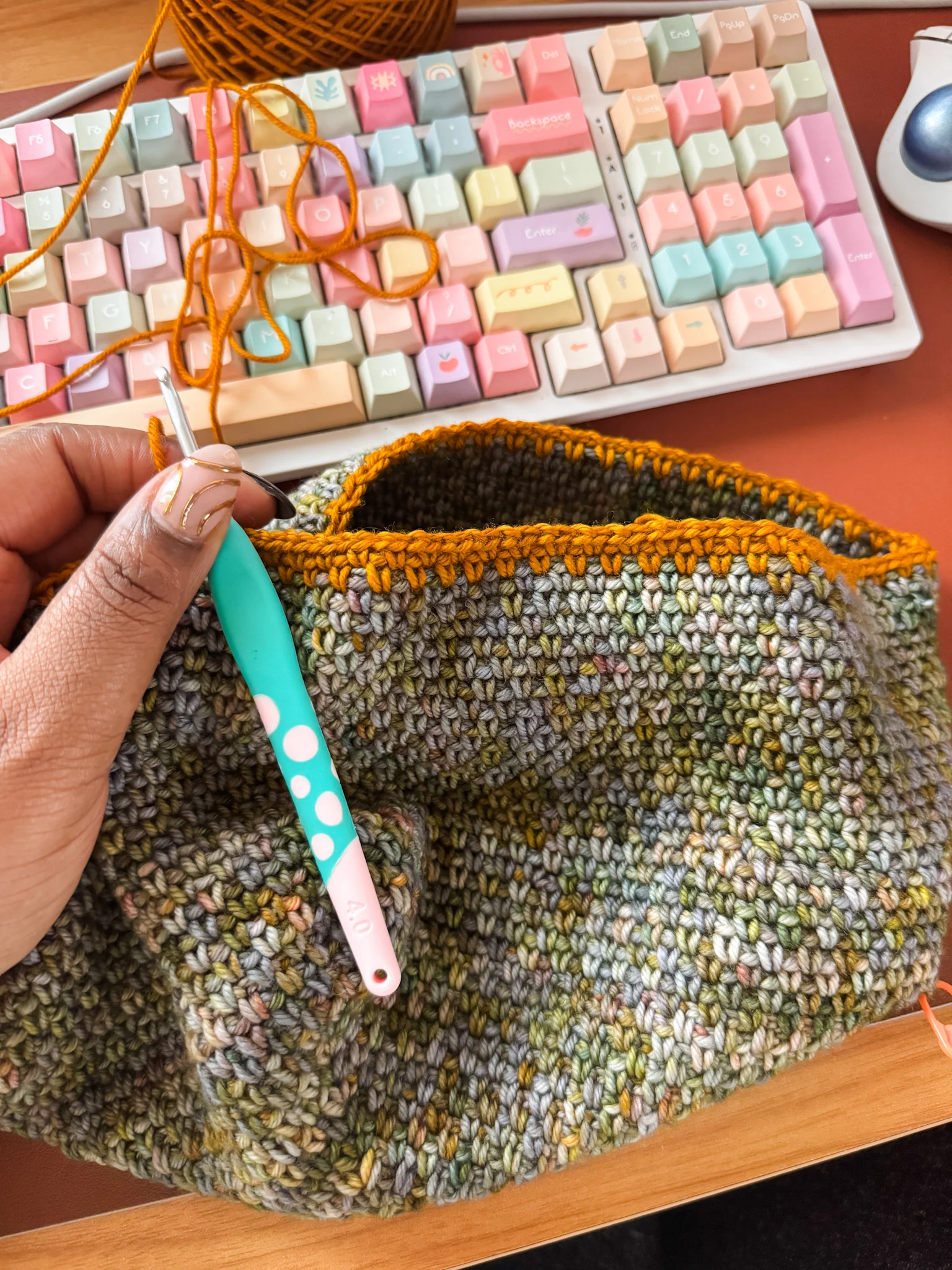
I never thought I’d have to buy my own stolen crochet pattern just to find out what someone else was selling.
But that’s exactly what happened.
A friend sent me the message no designer wants to get: “Your pattern has been stolen.”
When I opened the link, there it was: a poorly edited version of my Square One Project Bag photo inside an Etsy listing full of AI-generated images, suspicious copy, and a PDF claiming to teach makers how to crochet my design.
So I bought it.
Not because I wanted to give that seller a single penny, but because I needed to know what was actually being sold. Was it my real pattern? An AI-generated fake? Something a maker could actually follow?
The answer was frustrating, but not surprising: it was AI trash.
This post contains affiliate links that support the content on TLYCBlog.com. All opinions are my own. Find my Privacy & Disclosures Policy here.
CLICK HERE TO PIN THIS POST
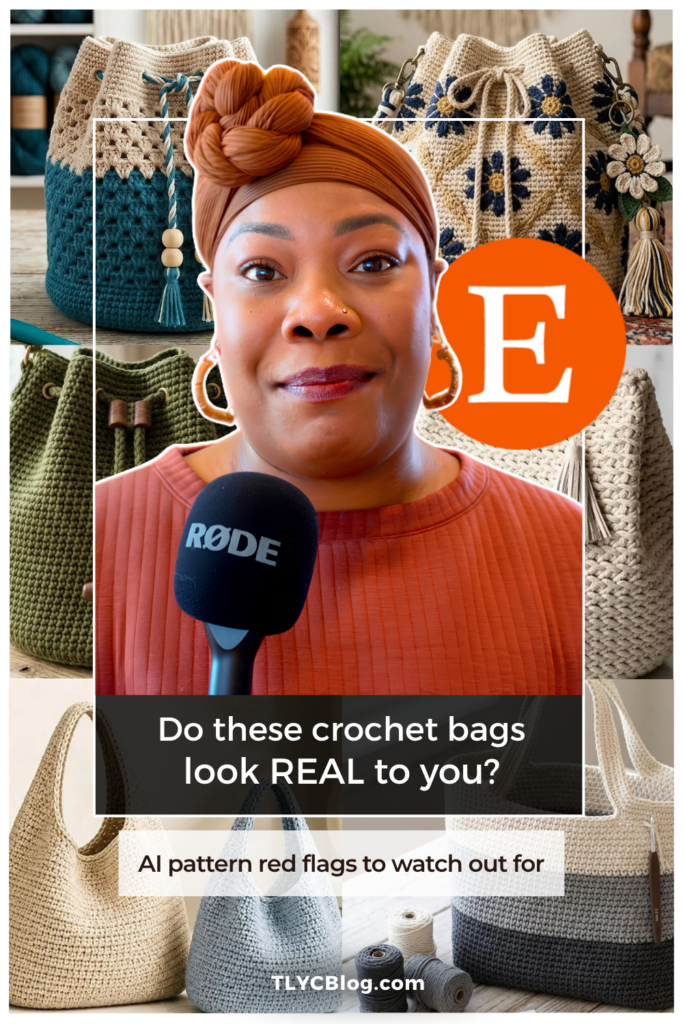
This Is Bigger Than One Stolen Pattern
The photo was stolen. The pattern name was stolen. The listing was misleading. And the PDF did not produce the bag shown in the images.
But the part that really gets under my skin? This is not just happening to me.
Fake crochet patterns are getting easier to make and harder to spot. AI tools can generate product images, descriptions, and pattern-like PDFs that look convincing at first glance, tricking makers into spending money on patterns that do not work while stealing attention, sales, and trust from the designers who actually created the work.
If you buy crochet patterns online, especially from marketplaces like Etsy, here are the red flags to watch for before you click “add to cart.”
How to Spot Fake Crochet Patterns and AI Red Flags
Fake crochet patterns are not always obvious at first glance. Some use stolen photos. Some use AI-generated images. Some use descriptions that sound polished but do not actually tell you anything useful. And some combine all of the above into a listing that looks real enough to fool makers who are just trying to buy a cute pattern.
Before you click “add to cart,” here are the red flags to look for.
1 // The Photos Look Too Perfect
Crochet is handmade. It has texture, shadow, softness, and the kind of small imperfections that make it real.
AI-generated images are getting better, but they still miss things crocheters notice immediately. Stitches look too smooth. Edges look too crisp. Rows look too perfect. The whole piece starts to look more like a computer-generated image than something someone actually made.
In the fake listing I found, one image was pulled directly from my Square One Project Bag photo and altered. The others looked AI-generated: too clean, too polished, and showing a completely different stitch pattern than my actual design.
Real designers usually show a project from multiple angles: front, back, inside, close-up stitch details, and the item being held or used. Those photos help you understand what you’re actually making.
If every photo looks like it came from a product catalog instead of someone’s craft room, look closer.
2 // The Stitches Don’t Match the Project
This is one of the biggest tells once you know what to look for.
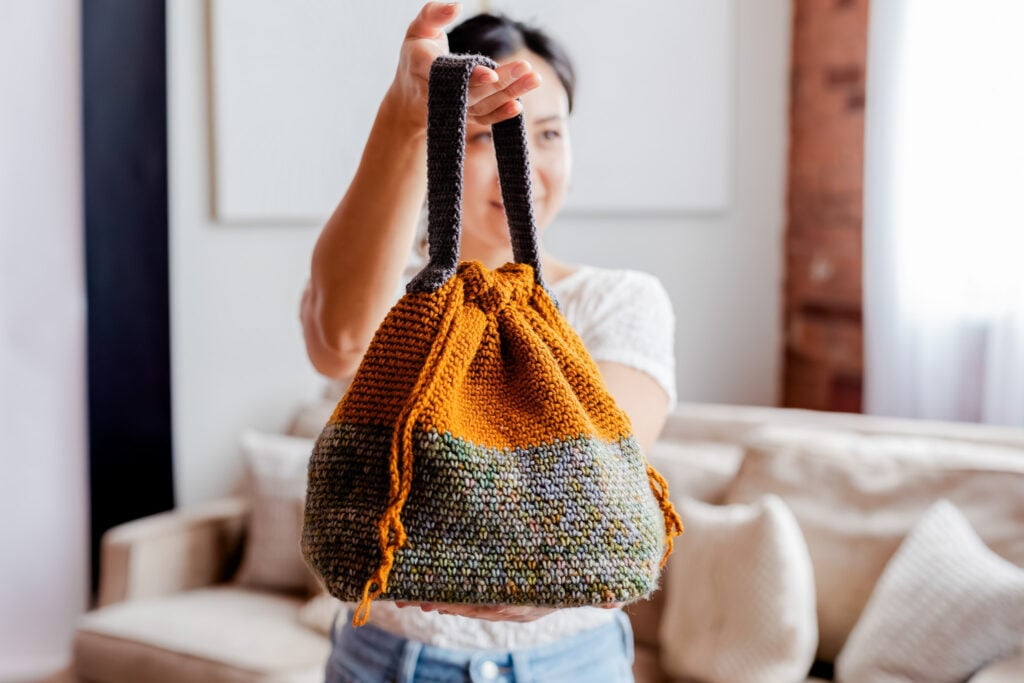
The Square One Project Bag uses linen stitch. The fake listing showed what looked like plain single crochet with random striping.
Those are not the same thing.
The stitch pattern in the photos should match the stitch pattern in the design. If the listing says granny stitch but the photos look like moss stitch, that’s a problem. If the photo shows intricate colorwork but the description gives no color-change information, that’s a problem. If the finished object does not match the written description, trust that instinct.
You do not have to catch every technical issue. Just look for consistency.
3 // The Materials and Measurements Don’t Add Up
A real pattern gives you practical, believable information: yarn weight, yardage, hook size, finished measurements, gauge, and special materials.
Fake patterns often get these details wrong in ways that sound fine at first.
The fake Square One PDF listed materials, measurements, and project capacity that sounded pattern-like until I read them as a crocheter. Then none of it made sense.
That’s what AI does. It produces words that sound confident. But AI does not crochet. It does not test the pattern. It does not know whether a bag with those dimensions actually holds three projects, whether that yarn comes in the listed size, or whether the instructions will produce anything close to the photo.
When you’re reviewing a listing, ask whether the yardage seems reasonable, the measurements are clear, the skill level matches the project, and the details sound like they were written by someone who has actually held a hook.
If the information feels vague, bizarre, or too generic, be cautious.
4 // The Listing Copy and Reviews Tell the Same Story
A lot of fake listings use descriptions that sound polished but do not actually say much. Repeated phrases. Broad benefits. Language that feels generated instead of written.
That alone does not prove anything. Real designers use marketing language too.
But pair generic copy with reviews that say the instructions were unclear, the finished project did not match the photo, or “I think this was made by AI,” and you have a much clearer picture.
Always read the actual words in the reviews, not just the star rating. In the shop I found, multiple customers mentioned confusing instructions and patterns that did not match what was pictured. One said outright that they believed it was AI-generated.
That is the kind of review worth finding before you buy, not after.
5 // You Can’t Find the Designer Anywhere Else
Before buying from an unfamiliar shop, do a quick search. Look for the designer’s name, shop name, or pattern image outside that one listing.
A real designer usually has some kind of presence: a website, Instagram, Ravelry page, YouTube channel, newsletter, or another pattern platform. Not always a big one. Some designers are new, small, or only sell in one place. That’s fine.
But if a shop is full of polished patterns and you can’t find the designer, the project, or the photos anywhere else, that’s a red flag worth taking seriously.
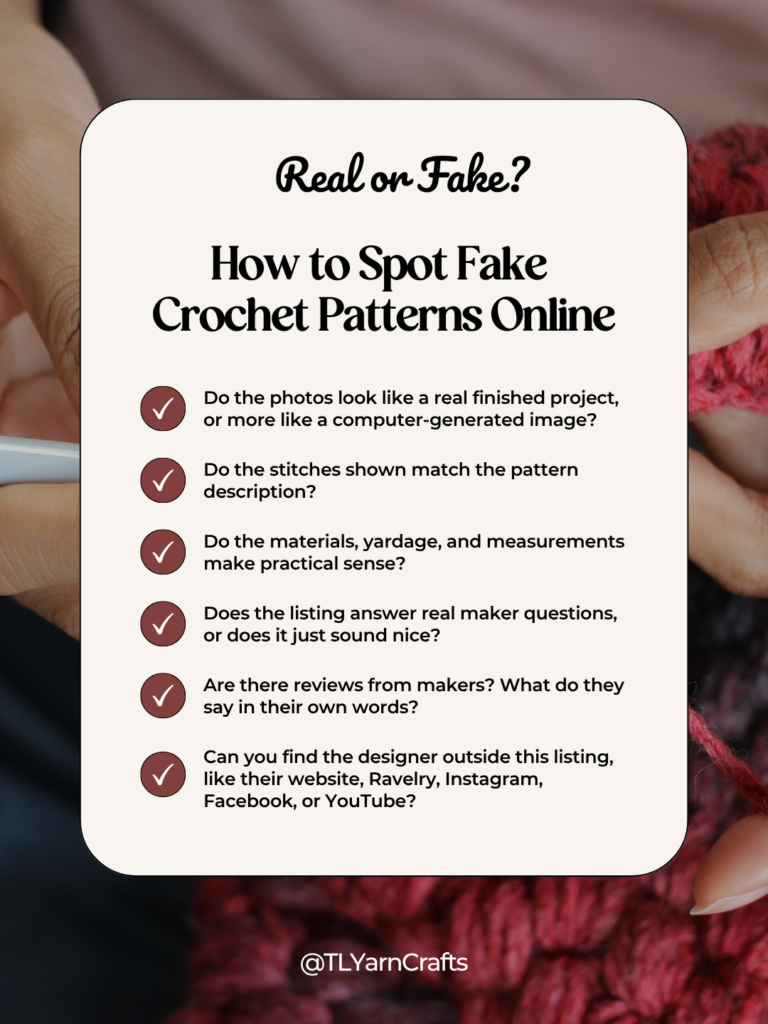
Save this quick checklist before your next pattern search so you know what to look for before you click “add to cart.”
What Designers Can Do, and How Makers Can Help
Designers should not have to spend their time policing stolen work. But until marketplaces do a better job, there are a few things that can help.
If you are a designer, keep your original pattern files, photos, publication dates, shop listings, and blog posts organized. If you ever need to prove ownership, having everything in one place makes the reporting process a lot easier.
Make your official links easy to find, too. Add them to your website, blog posts, YouTube descriptions, Instagram bio, newsletter, and anywhere else your audience finds you. The less confusion there is, the harder it is for fake sellers to intercept your customers.
And if you are a maker, your eyes matter more than you know. If you see a designer’s pattern, photo, or project being sold somewhere suspicious, send them the link. Most designers cannot catch everything on their own, and one message from the community can make a huge difference.
The Best Way to Support Real Crochet Designers
The best way to protect yourself and support real designers is to follow the official trail.
If a listing gives you pause, take one extra minute to look for the designer’s website, social channels, Ravelry page, or official shop links.
Trusted pattern platforms, designer websites, and official shop links are always the safest place to start. And if you are buying from an unfamiliar marketplace shop, read the reviews carefully before checking out.
You do not have to become an internet detective every time you want a new pattern. But when something feels off, slow down. A quick check can help you avoid fake listings and make sure your money goes to the maker behind the design.
Watch the Full Breakdown
If you want to see exactly how this fake listing looked, what made it suspicious, and what was inside the PDF I bought, I walk through the whole thing in the video below.
Want to make the real Square One Project Bag?
You can find the free pattern on the blog HERE, or grab the printable PDF from my shop HERE.
Have you spotted a suspicious crochet pattern listing, bought a pattern that did not match the photos or listing, or found your own work being used somewhere it shouldn’t be?
Drop down in the comments and tell me what you’ve seen. The more we talk about it, the better we can help makers spot the red flags and keep looking out for each other.


I am so sorry this is happening to you and other makers. I always buy me patterns on Ravelry or your website. I appreciate the work you and other designers put into designing. I thank you for your tutorials. They are so helpful. I will continue to go to the source, not Etsy!
Buying from Ravelry is your best bet, for sure. They’re the only platform I know of that’s actively protecting creators from AI and theft.
I check every designer on Ravelry before buying – they do a great job weeding AI out vs other platforms like Etsy!
Yes! I’m so grateful for Ravelry. They do a great job at protecting creators.
Thank you so much for this Toni!! So helpful. I’m really sorry this has happened to you and other designers too! Beyond frustrating for everyone!
Super frustrating, but I’m glad to be able to get the word out. It can be exhausting keeping up with the ways folks try to scam artists, but we have to stay vigilant.
I’m so sorry this has happened to you, and to other designers. I’ve purchased many patterns from Etsy with decidedly mixed results, including one crochet pattern I ordered before I knew how much of a problem this deceit is. It advertised “knit look,” and the image did look like knitting. The photo had ribbing at the neck, armholes, and lower hem. When I downloaded it, it was a tank pattern made exclusively in single crochet (so much for a knit look), and it specified no edging whatsoever, anywhere. I gave it a one-star review and reported the seller to Etsy (for all the good that did). The seller contacted me to ask what they could do to help me understand the pattern (?!?). We went back and forth until I finally used the words “fraud” and “bait-and-switch,” at which point he refunded the purchase price.
Do you know whether it helps to report these sellers to Etsy?
That’s awful that the pattern was misrepresented. I think it’s helpful to report AI and scam sellers, but I rarely report actual sellers. I just don’t buy from them anymore.
As a person trying to start an Etsy shop, I’m concerned about making sure people can tell that I’m not selling fake products. This list is helpful for me to make sure I have the right kinds of photos, clear and understandable descriptions, maybe using a ruler in the photos to show size, and using my other platforms to reinforce that I’m making things — by showing clips of me working on my products or talking about the inspiration.
Thank you.
I’m new to your YouTube channel and so glad that the algorithm thought I needed to see your content. It’s nice when the algorithm gets is right.
Hey there, AJ 🙂 Congratulations on starting a shop! We also suggest looking into other platforms like Ravelry or your own website, should you have the ability to do so. But, if you are going to use Etsy, take pictures in real life, possibly include models (if you have testers, this is a great thing to include!), and definitely show the process or the inspiration. Anything that makes it clear that you are a real person is helpful for the buyer. Clear descriptions with useful information is also great! I personally also suggest making sure there is a disclaimer in your description that you are selling a digital PDF pattern as your product and not a physical item should the buyer dispute it (if you are selling patterns). This is an issue some designers run into, so it is better to make sure it is taken care of ahead of time 🙂
I’ve shopped on Etsy a few times for patterns, I’m thinking I’ve been lucky. Having said I will try to navigate Ravelry better and use personal websites
Hey there, Patricia 🙂 Of course, some designers only sell on Etsy, so if you like someone’s work, don’t shy away if that is the only platform they use. We just suggest being cautious, buy elsewhere should a designer offer it, and watch out for scammers! We wouldn’t want any of our crochet community friends to get the short end of the stick
I always look for the designer’s name. If it isn’t there, beware!
Ugh this is becoming so frustrating! It’s not just crochet but knitting and sewing as well (& I’m sure all sorts of other crafts)and its becoming rampant. I feel so bad for all the legit designers that are having to deal with this! I almost fell prey to buy a sewing pattern the other day-but one of pictures I noticed the girl holding the bag had 3 arms. Now I’m trying to make sure I’m buying from designers I actually know!
Hey there, Michelle 🙂 Isn’t it crazy?? Unfortunately it is running rampant, and sometimes hard to avoid altogether. We suggest checking to see if the designer or maker has a digital and social presence, and if you wish to buy from them on Etsy, see if their shop is linked on one of their external profiles (ex. Insta, FB, website, etc.)
Thank you Toni for giving me this information and doing the work to give it to us all. I just love your channel and you have taught this knitter how to crochet
Hey there, Janice 🙂 Thank you for your kind words of support! We want to make sure our community is taken care of and in the loop
Hi Toni, I recently bought a pattern for a crochet “tree of life” wall hanging. I purchased from an online store that I had bought from before who I had found reliable previously. The ad for the pattern told me that there were us and uk instructions as well as photos and a graph pattern. When I downloaded it, there were 2 sets of instructions, but neither matched the graph and both were clearly AI written. Emails to the seller appeared helpful but did not solve my problem, so I did a deep dive, found the author of the pattern, and her notes were that there were NO written instructions and that the graph must be used. I have progressed with the graph and it seems to be working out. I notified the seller that the pattern is incorrect and notes were misleading and they thanked me for that. I am hoping that they have fixed the problem and contacted the author of the pattern. It appears they had no idea either…. Time consuming process and I have learned to only go thru Ravelry in future. And you of course… xxx
Hey there, Cheryl 🙂 If the Etsy seller you bought from is not an authorized seller of the original pattern by the author, and is stealing the pattern and claiming it as their own, you may want to report the item and the store, as well as notify the original author of the store. Even if they wrote instructions for the graph from the original author, it is still an infringement on the intellectual property. Good catch, and great that you did some deep diving and research!
Thank you. A very well thought-out blog with great tips.
Hey there, Chez 🙂 Thank you for your words of support! We always hope to help out the community and keep you all aware