

Ultimate Guide to Yarn Fibers: What Every Crocheter Should Know

When you’re just starting out with crochet, choosing yarn can feel like the hardest part of the project. You walk into the store, see a wall of gorgeous colors and textures, and think, where do I even start?
Here’s the thing: there’s a lot more to yarn than color and weight. The fiber your yarn is made from affects how it feels in your hands, how your stitches look, and how your finished project drapes, stretches, wears and washes.
That might sound like one more thing you have to learn, but I promise it doesn’t have to be complicated. Once you understand a few basic fiber types and what they do best, choosing the right yarn for your project gets a whole lot easier.
This post contains affiliate links that support the content on TLYCBlog.com. All opinions are my own. Find my Privacy & Disclosures Policy here.
CLICK TO PIN THIS POST
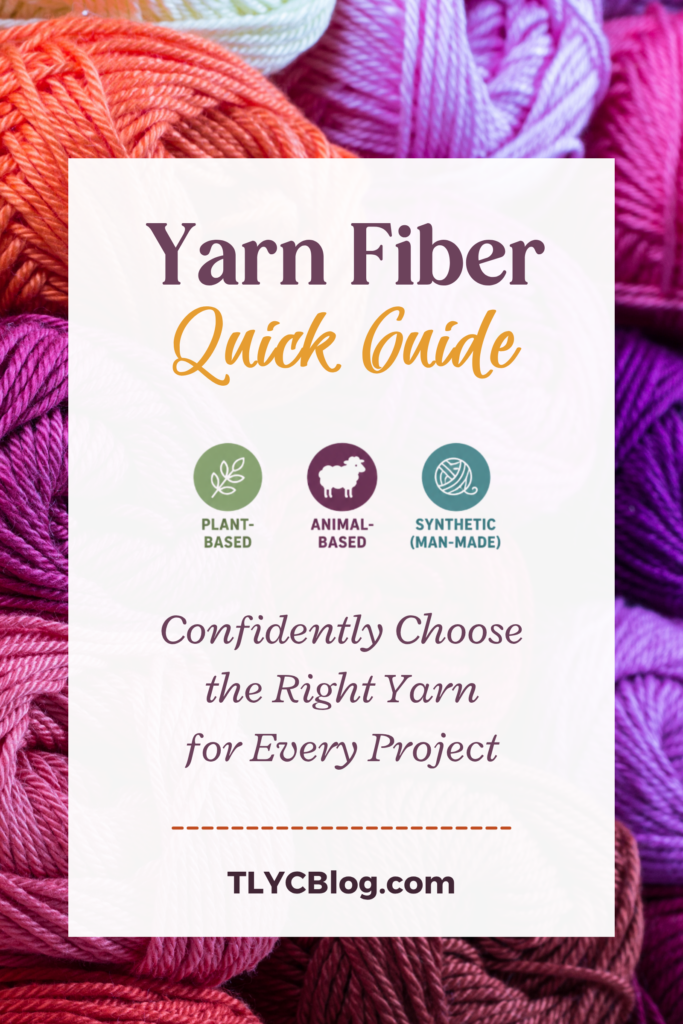
And because I want to make this as easy as possible, I made you a Yarn Fiber Cheat Sheet. It breaks down the most common fibers you’ll come across, their pros and cons, care instructions, and the kinds of projects they work best for. Download it, print it, or save it somewhere handy for the next time you’re choosing yarn.
What Is Yarn Fiber?
Simply put, fiber is what your yarn is made of. And while it might seem like a small detail on the yarn label, it can make a big difference in your finished project. Fiber affects everything from how the yarn feels in your hands to how much it stretches, drapes and holds up over time.
There are dozens of fibers out there (because apparently we needed even more choices in the yarn aisle!), but most of the ones you’ll come across fall into three broad groups: plant-based, animal-based and synthetic fibers.
Let’s break them down so you know what you’re looking at the next time you’re yarn shopping.
Plant-Based Fibers

Breathable, strong and comfortable in warmer weather. Plant-based fibers also offer excellent stitch definition, making them a great choice when you want your crochet stitches to really stand out.
- Cotton is strong, absorbent and breathable, with very little natural stretch. It gives you crisp stitch definition and works beautifully for dishcloths, bags, summer tops and baby items.
- Linen can feel a little crisp or stiff at first, but don’t let that scare you. It gets softer and more beautiful with every wash and wear. It’s especially lovely for lightweight garments, shawls and other warm-weather makes.
- Bamboo/Viscose has a silky feel, gorgeous drape and often a subtle sheen. It’s wonderful for flowy garments and lacy projects, though it can be slippery to work with and may need a little extra care.
// Overall Pros of Plant-Based Fibers:
Think cool, breathable and perfect for warm-weather makes. Plant-based fibers are a favorite for lightweight projects, home goods and anything where you want your stitch pattern to really shine.
// Overall Cons of Plant-Based Fibers:
Most have less elasticity than wool or acrylic, so they can feel less forgiving while you crochet. Some can also become heavy when wet, and fibers like linen may feel stiff until they’ve been washed and used.
// Best Projects for Plant-Based Fibers:
Dishcloths, bags, summer tops, baby items, shawls and lightweight garments.
Animal-Based Fibers

These are the fibers we reach for when we want warmth, coziness and beautiful texture. Many animal fibers also have natural elasticity, giving your crochet a little bounce and making these yarns especially nice to work with.
- Wool is a crochet classic for good reason. It’s warm, springy and forgiving, with natural elasticity that helps stitches bounce back into shape. It’s a great choice for hats, sweaters, scarves, blankets and all kinds of cozy projects.
- Alpaca is incredibly warm and known for its softness and gorgeous drape. It has less elasticity than wool, though, so garments made with alpaca can stretch or grow over time. You’ll often find it blended with wool or other fibers to get the best of both worlds.
- Mohair is lightweight, warm and wonderfully fuzzy. It creates that soft halo you’ve probably spotted in sweaters, shawls and other dreamy projects. It’s often held together with another strand of yarn to add warmth, texture and a little extra magic.
// Overall Pros of Animal-Based Fibers:
Warm, insulating and often naturally elastic. Many animal fibers also respond beautifully to blocking, which can help even out stitches and shape your finished project.
// Overall Cons of Animal-Based Fibers:
They can be more expensive and often require gentler washing and care. Some people also find certain animal fibers itchy or irritating against their skin, so consider where and how the finished project will be worn.
// Best Projects for Animal-Based Fibers:
Sweaters, hats, scarves, shawls, blankets and other cold-weather accessories.
Synthetic (Man-Made) Fibers

Affordable, durable and easy to find, synthetic fibers are workhorses in the crochet world. They’re especially useful for projects that need to stand up to lots of use and frequent washing.
- Acrylic is affordable, widely available and comes in just about every color you could want. It’s also easy to care for and forgiving to work with, making it a solid choice for beginners as well as blankets, garments and everyday projects.
- Nylon is strong, lightweight and slightly stretchy. You’ll often find it blended with other fibers to add durability and elasticity, especially in sock yarns and other projects that get a lot of wear.
- Polyester is durable, easy to care for and incredibly versatile. It’s often used to create specialty yarns, including the super-soft chenille and plush yarns popular for blankets and amigurumi.
// Overall Pros of Synthetic Fibers:
Affordable, widely available, durable and generally easy to care for. They come in a huge range of colors and textures and are especially practical for projects that will be used and washed often.
// Overall Cons of Synthetic Fibers:
They’re generally less breathable than natural fibers and can sometimes pill with wear. They also behave differently when blocked and can be sensitive to high heat, so always check the yarn label before washing, drying or blocking your finished project.
// Best Projects for Synthetic Fibers:
Beginner practice pieces, blankets, toys, accessories and everyday projects that need to stand up to regular use and washing.
What About Yarn Blends?
You’ll quickly notice that plenty of yarns aren’t made from just one fiber. Yarn companies often combine two or more fibers to bring their best qualities together.
A wool-acrylic blend, for example, can give you some of wool’s warmth and bounce with the durability and easy care of acrylic. Adding nylon to wool can make a yarn stronger and more resistant to wear, while blending cotton with a drapier fiber like bamboo or viscose can create a softer, more fluid fabric.
There’s no rule that says a 100% natural fiber is automatically better than a blend. What matters is how the yarn behaves and whether those qualities make sense for the project you’re making.
When you’re shopping, take a peek at the yarn label. You’ll find the fiber content listed as percentages, like 80% wool / 20% nylon or 50% cotton / 50% acrylic.
How Do You Choose the Right Yarn Fiber?
Here’s the good news: you don’t need to memorize the characteristics of every fiber before you buy yarn. Start by thinking about what you’re making and what you need the finished project to do.
Ask yourself a few questions:
- How will it be used? A hardworking baby blanket has different needs than a special-occasion shawl.
- How should it feel? Do you want something warm and cozy, cool and breathable, structured or beautifully drapey?
- Does it need stretch? A fitted hat or sweater may benefit from a fiber with some elasticity, while a market bag might need something sturdy that holds its shape.
- How will it be cared for? If you know something will be washed often, check the care instructions before committing to the yarn.
- What does the pattern recommend? There’s usually a reason the designer chose a particular yarn or fiber. You don’t necessarily need to use that exact yarn, but choosing something with similar characteristics will help you get a similar result.
Choosing yarn gets much easier when you stop asking, “Which fiber is best?” and start asking, “Which fiber is best for this project?”
Your Yarn Fiber Cheat Sheet

Keep your Yarn Fiber Cheat Sheet handy as you explore new yarns and projects. Use it as a quick reference when you’re comparing fibers, planning a project, or standing in the yarn aisle wondering which skein to bring home.
Need something durable and easy-care for a blanket? Cotton or acrylic might be a great place to start. Dreaming about a cozy sweater? Take a look at wool. Making something light and breezy for warmer weather? Linen or bamboo could be just the thing.
The more yarns you try, the more you’ll start to notice what you love working with and how different fibers behave in your crochet. There’s no single “best” fiber. It’s all about finding the right yarn for the project you want to make.


Premium acrylic and wool blends.
Thanks for this blog and the Fiber Cheat Sheet! You’re the best Toni!!!!!
Superwash merino is my go-to for most things other than kitchen accessories and the like. In the summer, however, I do like bamboo/cotton blends for wearables.
I have been wanting this type of information! Thanks so much. Especially love the fiber cheat sheet!
I’ve been afraid to try anything other than cotton or acrylic. Maybe this will help me try some wool.
Nearly all the yarn I have is cotton 🤍
Thank you, Ms. Toni! I’m still a beginner, but I love the feel of animal yarn blends with silk 😍
Knowing more about different yarns will help a lot thank you
This will be very helpful. Thanks.
I use acrylic, though I’d like to know which ones are softer. I use my LB 24/7 for dishcloths. It’s a good knit but it does not absorb as well as Premier cotton. Peaches and cream is just like stars, birds nest material. Need some gloves to work with that. Alpaca, goo bit a little pricey, but understandable. It’s from a live source. So my best would be a Merino wool that’s capable of machine washing and no pill.
Do you have patterns to purchase?
Yep! You can find them here – LINK
Could you explain which blocking method is right for each fiber?
It depends not only on your fiber but also your project. A wool hat wouldn’t be blocked the same as a wool sweater. My rule of thumb is – if it only needs light retouching, steam it. If it needs more, wet block it. And ALWAYS wet block sweaters folded so they don’t stretch out.
Wow great work. Thanks a lot
Thank you! I always wonder what I can use best for a project like kids blankets vs baby blankets or a summer shawl….
I hope this provided some insight for your future projects. Happy crocheting!
Thank you for so much ma, I really don’t understand all this point at the beginning but the one have been using is man-made
Thanks Toni for the info it is very helpful. I use acrylic, cotton.
Awesome! I’m so glad you found it helpful 🙂
I’m super new and still figuring out what fibers to use. Thank you for making this so easy to understand with all this information in one place. I’ve only worked with acrylic, cotton and polyester so far. I want to try wool and bamboo once I have more practice.
I use acrylic the most.
This Cheat Sheet is very helpful. I’ve always wanted to know which yarns to use. I mostly use Acrylic but lately I have been ordering kits just to have a better yarn.
I use cotton for hats for chemotherapy patients who have lost their hair. Gets softer with every washing, easy care and breathes in summer. I’ve made sweaters out of cotton, polyester and acrylic. Blankets are usually polyester. I try and use the yarn the designer suggests, but sometimes you just have to substitute
Acrylic, acrylic, and more acrylic. Wools are 1) too expensive and 2) scratchy. Now I can’t say I’ve tried alpaca or llama wool, but when I work with my fav SSDK yarn, I’m happy with the quality and results. Plus I love all the colors (120)!!
Thank you for your chart and pdf. I was wondering if you had information about other fibers. I am allergic to mammal fibers but have thought about exploring tencil or silk.
Choosing the fiber seems like step one, then we need to figure out the weight and texture.
Hi! Can I ask what information you’re looking for? My recommendation is to figure out what yarn weight you need for your project, then check your favorite yarn shops to see who has a wool-free option. If you need ideas on where to shop, you can find some in this video, and in this blog post.
I have bins of yarn, many have lost their labels. Is there an easy way to identify what kind of fiber the yarn is?
Wool, acrylic, blend?
Thank you
Hi! The best way to determine the fiber is with a burn test. You can find info on that here – FIBER BURN TEST
Thanks a lot informative!.
Thank you for the chest sheet. I’ve been crocheting consistently for the last 15 yrs. I’m just now starting to educate myself on natural fibers and trying to learn how to make wearables. It’s exciting, scary and frustrating all in one. This guide is very helpful as well as all your other resources.
GET IT GIRLIE!!!this helps me so much on what yarn to choose at the store and not be confused.
I’m so very glad this was helpful! I remember being a very lost newbie, gazing at the yarn aisle like a mystery to be unlocked. It’s nice when it’s broken down a bit 🙂 Thanks for stopping by!!
also how do I make a granny square?? thanks
Oooo, I love a good granny square. Since you’re already on my blog, check out this post, which has instructions and my top tips – LINK
Hi Toni!
Thank you for the cheat sheet, it will be beneficial when I go yarn shopping for a pattern I recently purchased. I’m going off a bit from what the designer used for the design. I know what I need and this guide will truly help me decide.
For the most part I reach for wool or wool blend and quality acrylic and acrylic blends. I’m getting more into cottons other than what I call kitchen cotton.
I splurged on a kit with 6 shades of purple in 100% silk and can’t wait to try it!